Source review: 7 October 2026 · Global. Client-data references below are independent database records, not NC announcements or our own gameplay tests. Routes and spending priorities are editorial suggestions; live unlocks, prices and reward prompts take precedence.
For most early Global progression, the safest AION 2 Daevanion Board priority is orange nodes first, useful blue active-skill nodes second, useful green passive-skill nodes third, then offensive grey stats, with defensive grey stats last unless survival is your immediate problem. Do not interpret that as an instruction to buy every node of one color. Choose an efficient path toward the strongest destination while collecting skill nodes that improve abilities you actually use.
Your class, current skill setup, and activity can change the exact route. A frequently used skill level can be more useful than an unrelated stat node, while a defensive upgrade can become the correct choice if incoming damage is stopping you from clearing content. Exact routes and values may also differ between regional versions, so Global players should use their own board labels and tooltips instead of copying a Taiwan or Korea screenshot node for node.
For the next decision, use the level 45 progression route, the matching upgrade checklist, and combat preparation.
Best Daevanion Board priority order
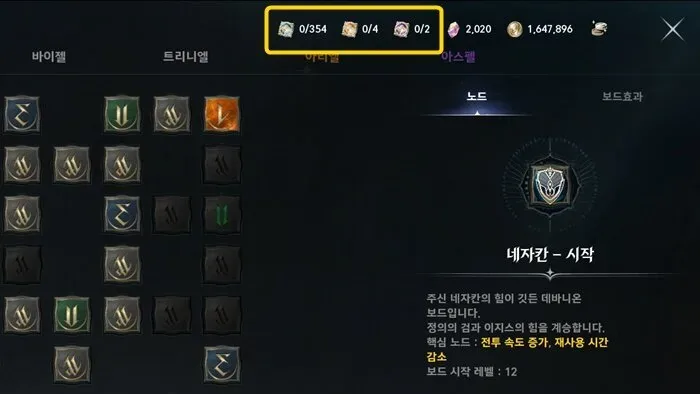
The board interface links the starting node to multiple upgrade paths.
Use this order as a general PvE framework rather than a rigid build:
| Priority | Node type | When to take it |
|---|---|---|
| 1 | Orange nodes | Make these your main destinations because they provide the board's most valuable major bonuses. |
| 2 | Blue active-skill nodes | Take them when they improve an active skill that is central to your current rotation or role. |
| 3 | Green passive-skill nodes | Take them when the passive directly supports your damage, healing, durability, or resource management. |
| 4 | Attack and critical bonuses | Fill these after the important colored nodes, or earlier when they sit on an efficient route and offense is your clear bottleneck. |
| 5 | Defense bonuses | Add these when survival is blocking progress; otherwise, leave broad defensive filling until the higher-impact nodes are secured. |
The core idea is to prioritize impact per point, not color alone. Orange nodes are the preferred destinations, but reaching one may require several connecting nodes. A route becomes much better when those connecting nodes include blue or green upgrades for skills already in your build. A shorter route full of relevant upgrades is normally more efficient than a long detour that contains bonuses your current setup cannot use.
Do not spend points merely because a node is available. Before confirming a route, identify its destination, count the required connecting nodes, and check every skill node along the way. The board should reinforce a working build rather than determine your build by accident.
What the node colors improve
The color system separates major bonuses, skill levels, and ordinary stat growth:
- Orange nodes provide powerful bonuses that contribute to character performance. These are the primary targets around which you should plan a route.
- Blue nodes add levels to active skills. Their value depends on whether the named skill belongs in your current loadout and how its next level changes the skill.
- Green nodes add levels to passive skills. They are valuable when the passive supports the content and role you are playing.
- Grey nodes provide raw stat increases. They connect the more distinctive nodes and become useful places to spend points after the essential colored nodes are covered.
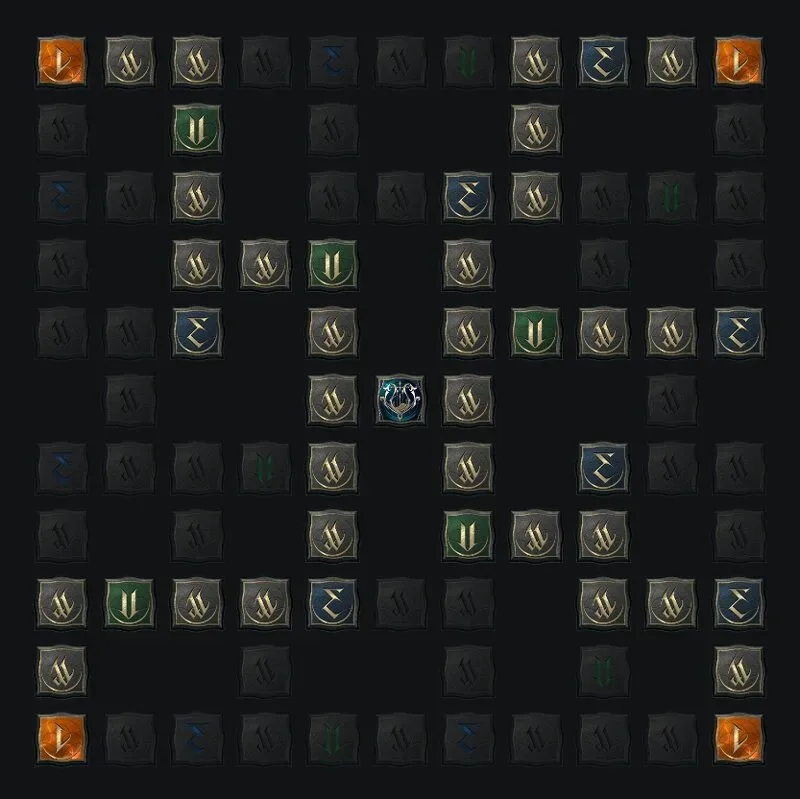
Node colors distinguish major bonuses, skill nodes, and stat nodes.
Blue and green nodes are not automatically equal for every character. An active-skill node is weak if you rarely cast that skill, and a passive node is weak if its condition does not occur in your content. Open the relevant skill details before spending. Check the current skill level, the next specialization threshold shown by the game, and whether your selected specialization actually benefits from the added level.
This check is especially important when looking at class-specific guides. A route built for a Cleric's group healing, a Ranger's early PvE rotation, or another class's specialized setup should not be copied onto an unrelated class. Class pages and build pages should decide which skills matter; the board then supplies those skill levels through the cheapest useful paths.
How to route Daevanion Points efficiently
Use the following process each time you gain a meaningful batch of points:
- Choose one immediate goal. Pick an orange destination, an active-skill level, or a passive-skill level that improves the content you are currently doing.
- Trace the shortest valid paths. Compare the connecting nodes required by each available approach rather than clicking toward the target immediately.
- Score the connecting nodes. Prefer a path that passes through active or passive skills already used by your build. Treat irrelevant skill nodes as part of the route's cost.
- Check nearby alternatives. A valuable blue or green node one step away can justify a small detour, but several low-impact grey nodes usually cannot.
- Spend only to the current milestone. Stop when the target activates. Reassess the board instead of continuing down the same branch automatically.
- Repeat with the next bottleneck. Move to another orange node, another important skill threshold, or a stat branch that addresses a demonstrated weakness.
This milestone approach prevents a common failure: investing deeply in one direction simply because the first few nodes looked good. Each completed target changes the value of the next point. Once a core skill has the level you need, another active-skill node may offer less than an orange destination or a useful passive on a different branch.
You should also avoid routing toward a skill solely because a guide calls it strong. Confirm that the skill is equipped, appropriate for your activity, and part of the rotation you can execute. The board cannot compensate for spending points on an ability that remains unused.
Adjusting priority for your current bottleneck
The default order changes when a specific weakness prevents progress.
When damage or healing output is too low
Keep orange nodes at the center of the plan, then favor blue and green nodes tied to your main output loop. For a damage setup, that means active attacks and passives that consistently affect the current PvE rotation. For a healing or support setup, it means the skills and passives used during the group's actual damage patterns. After those nodes, attack-oriented grey bonuses are the normal filler choice.
Do not assume critical bonuses are always the first offensive answer. Their practical value depends on the rest of the character's current setup. If a direct skill-level node unlocks a useful improvement shown in the skill interface, it offers a clearer reason to spend than blindly filling every critical node.
When survival is stopping the clear
Move relevant defensive bonuses ahead of optional offensive filler when you repeatedly die to unavoidable damage or cannot remain active long enough to perform your role. This is a targeted correction, not a reason to fill every defensive branch. Check positioning, mechanics, equipment, and skill use as well; the board should address a real stat bottleneck rather than cover an unrelated mistake.
Once survival is stable, return to major orange targets and useful skill nodes. Spending indefinitely on defense can slow progression if the encounter now fails because of low damage or insufficient healing instead.
When switching between solo and group content
Solo play may reward a balanced route that supports damage and self-sustain, while group content can increase the value of role-defining skills. Review your equipped skills before spending new points. A node that strengthens a solo farming ability may not help a group healing setup, and a group-oriented passive may contribute little during short solo encounters.
The board should follow the build you are using now. Do not import another class's route simply because its screenshot is easy to follow.
When preparing for PvP
Treat the Azphel PvP board as a separate objective from ordinary PvE progression. Daevanion Points sold through the Abyss Trade Shop apply to that PvP board, so they should not be mistaken for general board progress. If PvE is your immediate goal, finish the important PvE destinations before making the PvP board your main priority. A player actively focused on Abyss content can reverse that decision, but should do so deliberately.
How to get more Daevanion Points
Supported point sources include exploration and side activities rather than character levels alone. Check unfinished Regional Quests, Sealed Dungeons, and Strongholds when your board route stalls. These activities contribute permanent progression while also helping you find points that may have been skipped during a fast trip through the main path.
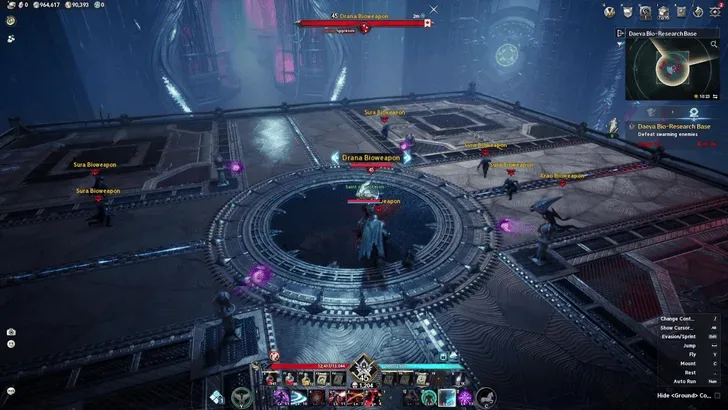
The Daeva Bio-Research Base is an activity source for Daevanion Point progression.
Trade Shops provide another route. Daevanion Points can appear in shops connected to Shugo Festival, Nightmare, and Abyss activities. Shop currency has competing uses, so seeing Daevanion Points in stock does not automatically make them the correct first purchase. Compare the next board milestone with the other upgrade currently blocking you.
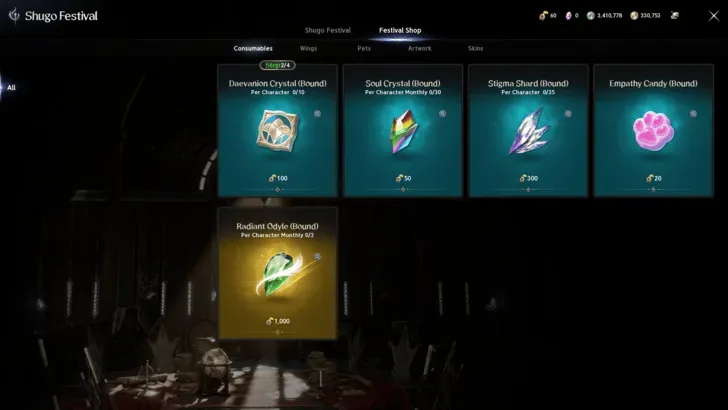
The Trade Shop displays the Daevanion Crystal reward and its currency cost.
Use this short decision rule before an exchange:
- Buy general Daevanion Points when they immediately complete a high-impact orange, blue, or green milestone and the alternative purchase is less urgent.
- Delay the purchase when the points would only open minor filler nodes while another shop reward solves a more immediate progression problem.
- Treat Abyss Trade Shop points as PvP-board resources, not as interchangeable points for the general PvE route.
- Recheck the shop and point description in the Global client before committing currency, especially when following advice created for another region.
The exact choice between Daevanion Points, Stigma resources, and other shop rewards belongs to a broader resource-priority decision. For this board plan, the important test is whether the purchase completes a concrete node target now.
A safe early progression plan
A cautious board plan can be divided into four phases.
Phase 1: Establish the main route
Pick the nearest high-value orange destination that supports general performance. Map the path without spending, then choose the version that passes through useful skill nodes. Avoid long side branches unless they contain an upgrade your current setup needs immediately.
Phase 2: Secure core skill nodes
Collect nearby blue and green nodes for the active and passive skills central to your current build. Verify each named skill in the interface. If the node affects an unequipped skill or an unsuitable specialization, leave it for later even if it is close.
Phase 3: Expand to another valuable destination
After the first cluster of meaningful colored nodes is complete, compare other boards or branches instead of filling all nearby grey nodes. Another orange destination or inexpensive skill upgrade may offer more progress than finishing the current area.
Phase 4: Fill stats around completed milestones
Use remaining points on offensive bonuses when output is the goal. Add defensive bonuses when survival is demonstrably limiting the content you can complete. This is the stage where ordinary stat nodes become deliberate upgrades rather than unavoidable route costs.
Do not build the plan around an assumed total number of obtainable points or an assumed cost to max every board. Current Global planning is safer when each stage works with the points already shown on your character. That keeps the route functional even if older regional totals, board sizes, or node values do not match the Global version.
Common Daevanion Board mistakes
- Copying a complete screenshot without checking the region. Use Global node labels and values. Regional layouts may not be suitable for exact duplication.
- Buying every nearby node. Adjacency does not make a node efficient. Spend toward a defined destination.
- Prioritizing color without checking the skill. A blue or green node is valuable only when its named skill contributes to the current build.
- Taking raw stats before core colored nodes. Grey attack, critical, and defense bonuses are usually follow-up investments, not the first objective.
- Overinvesting in defense by default. Defense should move up when survival blocks progress, not simply because defensive nodes are available.
- Treating the PvP board as general progression. Abyss Trade Shop points are associated with the Azphel PvP board and should be planned separately.
- Assuming every shop point purchase is mandatory. Complete a specific milestone with the purchase; otherwise, compare the competing reward first.
- Following a class route on the wrong class. Use class and build guidance to identify important skills, then apply the routing method to your own board.
- Continuing down a branch after reaching the target. Stop at each milestone and compare the next available improvement across the board.
When to move to another board or branch
Move on when the current branch's remaining nodes are mostly low-impact filler, while another branch offers a reachable orange node or a relevant skill level. Staying on one board until it is visually complete is not the objective. The objective is to assemble the best set of useful milestones from the points currently available.
Before leaving a branch, confirm three things: the desired orange node is active, the nearby active and passive nodes relevant to your build are collected, and the remaining stats do not solve a current bottleneck. If all three are true, compare the next orange destination on another board with any unfinished offensive or defensive bonuses.
This produces a board that remains useful throughout progression: major bonuses establish the route, relevant skill levels strengthen the build, and raw stats finish the areas that actually need support. Recheck those priorities whenever you change class setup, role, or primary activity rather than treating the first route as permanent.
Sources and verification
- MetaBot Daevanion planner and records — Independent provider: board layouts and skill nodes; priority order is an editorial recommendation.
- MetaBot database methodology — Independent data provider: reports parsing Global client build 0.0.4387.0. Client records do not prove live activation or server-side behavior.