Source review: 7 October 2026 · Global. Client-data references below are independent database records, not NC announcements or our own gameplay tests. Routes and spending priorities are editorial suggestions; live unlocks, prices and reward prompts take precedence.
Increase Combat Power in AION 2 by fixing your largest missing source of stats instead of pouring every resource into equipment. Start by filling every equipment slot and replacing outdated gear, then complete Regional Quests and Exploration for permanent Daevanion progress. After that, improve the skills and Stigmas you actually use and collect persistent bonuses from Wings, Skins, Titles, Pets, Genus Insight, and the Pantheon.
Combat Power and Item Level are not interchangeable. Item Level matters for meeting the entry requirements of certain Expeditions and Transcendence stages, while Combat Power reflects a wider range of character-progression systems. A character can therefore reach an Item Level requirement while still missing substantial power from skills, permanent stats, or collections.
Use current Global menus and requirements when checking your progress. Older regional guides may show different level caps, rating formulas, upgrade targets, or systems, so their numerical milestones should not be copied directly into the Global version.
For the next decision, use the level 45 progression route, the matching upgrade checklist, and Daevanion priorities.
Use This Combat Power Priority Order
Work through these steps in order, stopping whenever you find a clear weakness:
- Fill every weapon, armor, and accessory slot.
- Replace obviously outdated equipment with stronger quest or dungeon rewards.
- Apply sensible upgrades to equipment you expect to keep, prioritizing the pieces that affect your current bottleneck.
- Complete nearby Regional Quests and Exploration objectives for Daevanion Points and other permanent rewards.
- Invest Daevanion Points according to the build and activity you currently play.
- Upgrade the core skills, buffs, defensive tools, and Stigmas used in your active loadout.
- Claim accessible permanent bonuses from Wings, Skins, Titles, Pets, Genus Insight, and the Pantheon.
- Check that your active preset actually equips the intended gear, skills, Stigmas, and Title.
- Recheck both Combat Power and Item Level, then choose the next upgrade based on whichever requirement is blocking you.
This order prevents a common mistake: spending heavily on a small late-game bonus while an empty slot, neglected quest reward, or unused upgrade material could provide a simpler improvement.
Separate Combat Power from Item Level
Combat Power is a broader rating of your character's progression. It accounts for progression beyond the visible level of your equipment, including character systems that grant additional stats. Item Level is narrower and remains important because some activities use it as an access requirement.

Use this panel to record Combat Power before and after upgrades.
Check both numbers before deciding what to improve:
| Current situation | Most useful response |
|---|---|
| Item Level is below an activity requirement | Replace or improve equipment first |
| Item Level is acceptable but Combat Power looks low | Audit Daevanion, skills, Stigmas, collections, Pets, and Pantheon bonuses |
| Both values increased but performance still feels weak | Check stat relevance, loadout choices, skill rotation, and mechanics |
| One preset is weaker than another | Verify every equipped component after switching presets |
| Progress has become disproportionately expensive | Stop and look for unfinished permanent or collection bonuses |
Neither value guarantees that a group will accept you or that you can clear a fight. Party expectations can exceed the formal entry requirement, and support-focused builds may not be represented as favorably as damage-focused builds by a single rating. Treat Combat Power as a diagnostic summary, not a substitute for useful stats, correct skills, encounter knowledge, or execution.
Record your current Combat Power and Item Level before changing anything. Make one category of upgrades, equip the resulting changes, and compare again. This makes it easier to identify which system is actually moving your character forward instead of spending across several menus without knowing what helped.
Fix Equipment Before Chasing Small Bonuses
Equipment is the most direct source of early Combat Power. While progressing through the Main Story, equip stronger rewards as they appear and keep every available slot filled. Main Story and Regional Quests provide starting equipment, while Expeditions become an important source of replacements as your character advances.
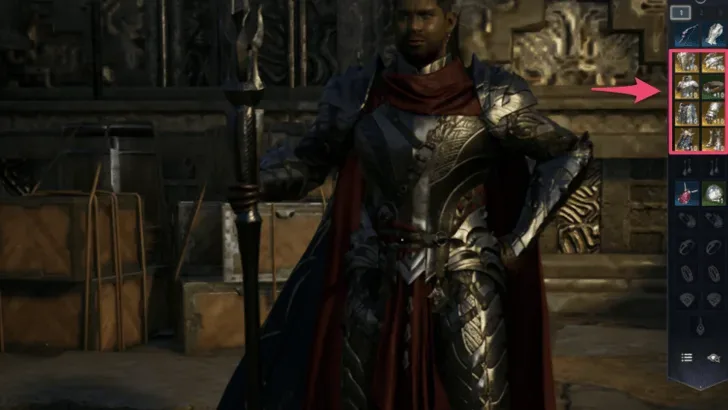
The equipment screen makes empty or outdated slots easy to audit.
Audit equipment slot by slot:
- Confirm that nothing is empty.
- Compare newly acquired weapons, armor, and accessories with the pieces currently equipped.
- Check whether an item belongs to the preset you are actually using.
- Look for relevant equipment upgrades and embedded stat systems that have been ignored.
- Prioritize the weapon and other pieces that most directly address your present damage, survival, or access requirement.
- Replace quest gear gradually rather than waiting for an entirely new set.
Do not enhance every temporary item simply because it raises the number today. Early and transitional equipment can be replaced quickly, while enhancement materials and Kina remain useful later. Exact stopping points depend on the current item, its replacement path, and the Global version's live rules; a fixed threshold copied from an older regional guide is not reliable.
The same caution applies to valuable stones and deeper equipment-investment systems. A modest upgrade on a durable piece may be useful, but spreading expensive materials across equipment that will soon leave your build can slow your next meaningful upgrade. Before committing, ask whether the piece solves a current gate and how likely you are to replace it soon.
Item Level should lead your priority when it is the explicit blocker. If you already meet the relevant entry requirement, do not assume another equipment enhancement is automatically the best Combat Power gain. Check the permanent systems below before spending more.
Build Permanent Power Through Exploration and Daevanion
Daevanion is a permanent progression system that can be developed alongside equipment. Regional Quests and Exploration objectives provide Daevanion Points, which can be invested into progression boards for additional stats and bonuses.
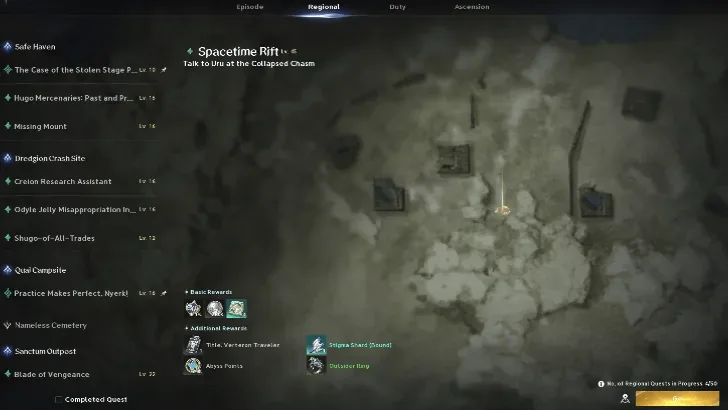
Regional missions contribute to long-term Daevanion progression.
Complete objectives near your route while advancing through the Main Story. This reduces backtracking and builds permanent progress without replacing your main leveling path. At level 45, unfinished Regional Quests and Exploration become especially valuable audit targets because character growth expands beyond ordinary leveling and quest equipment.
Use this process:
- Open the relevant quest and Exploration menus and identify incomplete objectives in reachable areas.
- Clear convenient objectives near your current activities first.
- Claim the rewards instead of leaving completed entries uncollected.
- Open the Daevanion board and review available stat paths.
- Invest toward the needs of your active build rather than distributing points without a plan.
- Recheck the board when your role, content target, or build changes.
Daevanion progress is valuable because it remains relevant when individual equipment pieces are replaced. However, this page does not prescribe one universal board route. Damage, defense, group role, and current content can change which path is useful, and each class has its own build priorities.
Exploration can also expose other permanent rewards and collection objectives. Focus first on accessible activities with clear stat or progression value. A difficult or inconvenient objective does not need to interrupt all other progress; mark it for a later return after your equipment and movement options improve.
Upgrade the Skills and Stigmas You Actually Use
Skills and Stigmas contribute to character strength, but equal investment across every available ability is inefficient. Upgrade the actions that define your active rotation: core damage skills, essential buffs, important defensive tools, healing abilities when relevant, and the Stigmas equipped for your current activity.

Review the skills and Stigmas used by the current preset before spending materials.
Follow a loadout-first approach:
- Choose the preset used for your immediate goal, such as solo PvE, group content, or PvP.
- Identify the abilities pressed consistently in that preset.
- Prioritize the skills responsible for its main damage, survival, healing, or group utility.
- Confirm which Stigmas are actually equipped.
- Spend limited upgrade materials on those Stigmas before improving unused alternatives.
- Test the complete loadout and make sure a preset switch did not unequip part of it.
Combat Power is not the only consideration. An upgrade can improve a displayed rating without fixing a weak rotation, missing defensive response, or role requirement. Conversely, a support ability may be crucial to a group even if a damage-oriented rating does not fully reflect its value. Select upgrades for what the build must accomplish, then use Combat Power as confirmation that the character is progressing.
Avoid copying another class's priorities. The Global release has eight classes, and their useful damage, defensive, healing, and utility abilities differ. A skill or Stigma that is central to one build may be irrelevant to another.
Add Collection and Housing Bonuses
Once equipment, Daevanion, and the active skill loadout are in reasonable shape, audit the persistent bonuses that are easy to overlook. Wings, Skins, Titles, and Pets can contribute owned or equipped effects, while Pet progression feeds into Genus Insight. Pantheon displays provide another source of character stats.
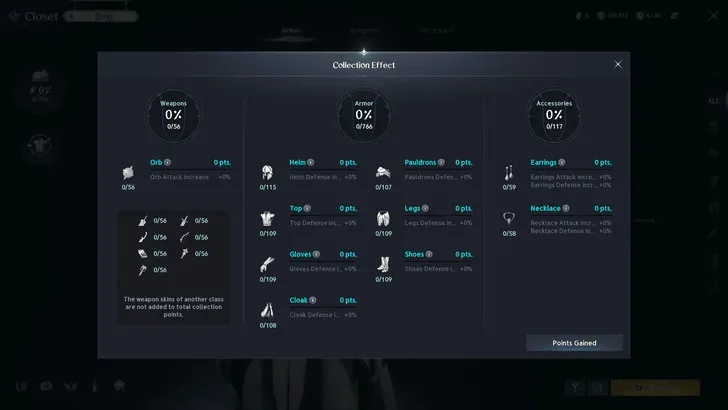
Collection effects provide persistent bonuses beyond direct equipment upgrades.
Check collection systems methodically:
- Review owned Wings and compare both owned and equipped effects.
- Inspect Titles you have unlocked and equip the one that suits the active build.
- Check stat contributions from acquired weapon, armor, and accessory Skins.
- Review the Pet collection instead of looking only at the currently summoned Pet.
- Claim completed achievements that unlock Titles or other permanent rewards.
- Confirm that the selected collection effects match the activity you are preparing for.
These systems become more valuable over time because their bonuses accumulate across multiple unlocks. They should not replace basic equipment progression, but they can explain why two characters with similar Item Level have different Combat Power.
Improve Pets and Genus Insight Gradually
Pet collection and Genus Insight provide additional bonuses as you acquire and develop Pets. This is long-term progression, so start with available collection gains before committing large amounts of Kina to repeated optimization.

Genus Insight is a long-term source of Pet-related bonuses.
Review the bonuses already available from your Pet collection, then improve the options that support the current build. Avoid chasing an expensive perfect result while equipment slots, Daevanion Points, or core skills remain unfinished. Those earlier systems usually provide a clearer foundation and are easier to evaluate.
Fill Useful Pantheon Displays
The Pantheon can grant stats through displays such as Colossi, Statues, and Artworks. Open the Pantheon and check whether useful displays are missing, outdated, or simply not placed.
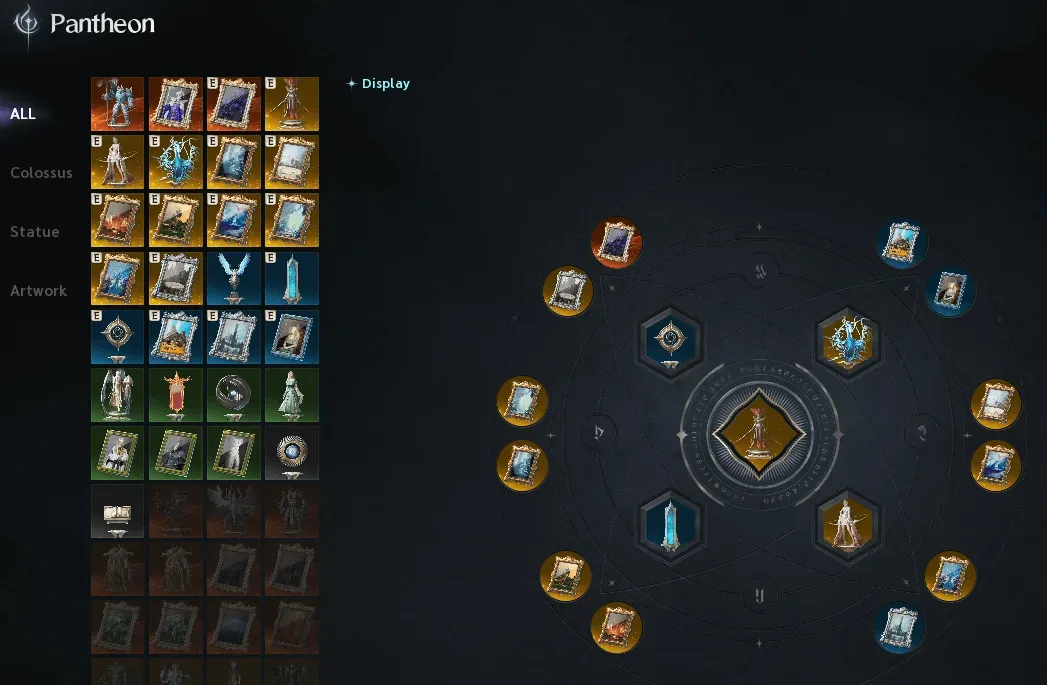
Check the Pantheon display slots for missing permanent bonuses.
Treat Pantheon improvements as persistent progression. Install accessible upgrades and revisit harder rewards as your character becomes capable of clearing the relevant content. Do not spend rare currency on a display merely because it raises Combat Power; compare that purchase with other upgrades competing for the same resource.
Avoid Expensive Combat Power Traps
Increasing Combat Power efficiently is partly about refusing bad upgrades. The following mistakes can make the number rise slowly while exhausting resources needed for the next real improvement:
- Over-enhancing equipment that is about to be replaced.
- Spending valuable stones across every transitional item.
- Upgrading skills or Stigmas that are not used in the active build.
- Chasing perfect Pet or Genus Insight results before completing basic progression.
- Buying a collection item without comparing its cost with other permanent upgrades.
- Copying old Taiwan or Korea numerical targets into the current Global version.
- Spending dungeon reward energy without a specific desired reward or progression goal.
- Treating Item Level padding as proof that the build is ready for difficult content.
When an upgrade becomes expensive, calculate its practical purpose in plain terms. Does it unlock an activity, strengthen a core ability, add a permanent bonus, or fix a survival problem? If the answer is unclear, preserve the resource and complete a more certain improvement first.
This is particularly important for currencies shared by several progression systems. A purchase that provides an immediate rating increase may delay a more useful Stigma, Daevanion, equipment, or collection improvement. Base the decision on your current bottleneck rather than the menu that happens to be open.
Diagnose a Combat Power Plateau
If Combat Power stops increasing, run a complete audit instead of repeating the same activity.
Equipment audit
Check for an empty or forgotten slot, an unclaimed quest reward, a stronger item left in inventory, or a preset still using an older piece. Confirm that applicable upgrades are attached to the item you actually equipped.
Permanent-progress audit
Look for unfinished Regional Quests, convenient Exploration objectives, unspent Daevanion Points, and completed rewards that have not been claimed. Permanent progression is easy to miss when attention is fixed on dungeon drops.
Loadout audit
Verify the active skills, Stigmas, Title, gear preset, and other selectable effects. After switching presets, inspect the entire setup rather than assuming every component transferred correctly.
Collection audit
Open Wings, Skins, Titles, Pets, Genus Insight, and Pantheon one by one. Look first for bonuses you already own but have not activated, placed, claimed, or equipped.
Performance audit
If the number rises but your results do not, examine stat relevance and execution. Combat Power cannot confirm that your rotation is correct, your defensive timing is reliable, or your group role is being fulfilled. Use actual combat performance to decide whether the next upgrade should add damage, accuracy, durability, healing, or utility.
Maintain Progress Without Wasting Resources
A simple maintenance routine keeps the major systems moving without turning every session into a long checklist:
- Equip clear upgrades obtained during normal play.
- Complete convenient Regional Quests and Exploration objectives along your route.
- Spend Daevanion Points only after checking the active build's needs.
- Upgrade the core skills and equipped Stigmas when materials are available.
- Claim newly earned Titles, Pets, Wings, Skins, and Pantheon displays.
- Compare Combat Power and Item Level after each meaningful batch of changes.
- Save expensive materials when no upgrade solves an immediate bottleneck.
The central rule is to improve the weakest relevant system. Equipment handles early gaps and entry requirements, Daevanion supplies permanent progress, skills and Stigmas strengthen the active kit, and collections add accumulated power over time. Keeping those systems balanced produces steadier gains than forcing every resource into a single visible number.
Sources and verification
- MetaBot database methodology — Independent data provider: reports parsing Global client build 0.0.4387.0. Client records do not prove live activation or server-side behavior.
- MetaBot skill database — Independent provider: class skills and tooltips; build choices on this site are editorial suggestions.
- MetaBot enhancement data and calculator — Independent provider: item-specific client rates; expected costs are calculations, not guarantees.